

Is the traditional “factory model” of education still effective in today’s world? As classrooms evolve, many educators are shifting toward approaches that focus on individual student needs. This change is driven by the growing demand for self-directed learners in the workforce and the success of innovative models like Summit Public Schools.
A 2018 Education Week survey revealed that 97% of schools now use digital tools to tailor education. Summit Public Schools, with its 12 campuses, has shown remarkable results by implementing this approach. Supported by a $40 million investment from the Chan Zuckerberg Initiative, their model emphasizes learner profiles, flexible environments, and competency progression.
While studies like the RAND Corporation’s 40-school research show modest gains, the potential for growth is clear. This article explores how personalized learning transforms education, its benefits, and strategies for successful implementation.
Key Takeaways
- Personalized learning adapts education to meet individual student needs.
- 97% of schools use digital tools for tailored education.
- Summit Public Schools’ model has gained significant support and success.
- Competency progression and flexible environments are key components.
- This approach aligns with workforce demands for self-directed learners.
What is Personalized Learning?
Education is evolving, and so are the methods to meet student needs. This shift focuses on creating an environment where every learner can thrive. By tailoring instruction to individual strengths and challenges, schools are moving away from one-size-fits-all approaches.
Definition and Core Principles
At its core, this approach adapts teaching to fit each student’s unique needs. Organizations like iNACOL define it as tailoring learning by strengths and needs, with a focus on student voice and choice. The Gates Foundation outlines four key attributes:
- Learner profiles: Understanding each student’s strengths and challenges.
- Personal paths: Customizing the journey based on individual goals.
- Competency progression: Advancing based on mastery, not age.
- Flexibility: Allowing students to learn at their own pace.
How It Differs from Traditional Education
Traditional classrooms often follow a rigid, age-based structure. In contrast, this modern approach emphasizes student-driven content and flexible pacing. While older methods relied on lectures, today’s classrooms use adaptive software and project-based autonomy to engage learners.
For example, instead of grouping students by grade, they progress based on competency. This shift empowers students to take control of their education, preparing them for real-world challenges.
The Importance of Personalized Learning
In today’s educational landscape, addressing individual student needs is more critical than ever. Traditional methods often fail to engage learners, leading to disconnection and lower achievement. Tailored approaches, however, focus on meeting students where they are, fostering both academic and personal growth.
Meeting Individual Student Needs
Every student has unique strengths, challenges, and interests. Tailored education ensures that these factors are central to the learning process. For example, Middletown, NY, successfully closed its achievement gap by focusing on individual needs. Their approach included targeted interventions and flexible pacing, allowing students to progress at their own speed.
Research by RAND highlights the efficiency of the zone of proximal development, where students learn best when challenged just beyond their current abilities. This method not only boosts academic performance but also builds confidence and skills.
Enhancing Student Engagement
Engagement is a key factor in student success. A Gallup poll revealed that traditional schools often see a decline in engagement as students advance. Tailored education counters this by making learning relevant and interactive. Syracuse City School District, for instance, improved engagement by incorporating project-based activities and real-world applications.
Fairbanks North Star Borough in rural Alaska also saw positive results by adapting its curriculum to local interests. This approach not only increased attendance but also fostered a deeper connection to the material. By aligning lessons with students’ passions, schools can create a more meaningful and engaging experience.
Employers increasingly value self-directed learners, and tailored education prepares students for these demands. Loudoun County, VA, for example, integrates global workforce preparation into its curriculum, ensuring students are ready for future challenges.
Benefits of Personalized Learning
Tailored approaches in education are reshaping how students achieve success. By focusing on individual needs, schools are unlocking potential and fostering growth. This method not only improves academic performance but also prepares learners for future challenges.
Improved Academic Outcomes
Research shows that tailored strategies lead to significant academic gains. A 2017 RAND study found an 11% improvement in math scores among schools using this approach. Schools like Belmont-Cragin Elementary in Chicago saw better outcomes after adopting these methods.
Key factors include:
- Focusing on problem-solving over memorization.
- Using data-driven grouping to address specific needs.
- Aligning lessons with students’ strengths and interests.
Increased Student Motivation
When education aligns with their interests, students become more engaged. A Gallup poll highlights the correlation between engagement and achievement. Tailored methods, like project-based activities, make learning relevant and exciting.
For example, Fairbanks North Star Borough in Alaska adapted its curriculum to local interests. This not only boosted attendance but also deepened students’ connection to the material.
Better Preparation for Future Careers
Tailored education equips students with essential skills for the workforce. Competency-based progression ensures they master key concepts before advancing. This approach aligns with employer demands for self-directed learners.
As highlighted in the benefits of tailored education, this method prepares students for the new economy. It emphasizes tech skills, collaboration, and real-world problem-solving.
“The future belongs to those who can adapt and learn independently.”
By focusing on individual goals, schools are creating confident, capable learners ready to tackle future challenges.
Key Components of Personalized Learning
Modern education is shifting toward methods that prioritize individual student growth. These approaches focus on creating pathways that align with each learner’s strengths and goals. By leveraging technology and data, schools can better meet the unique needs of their students.
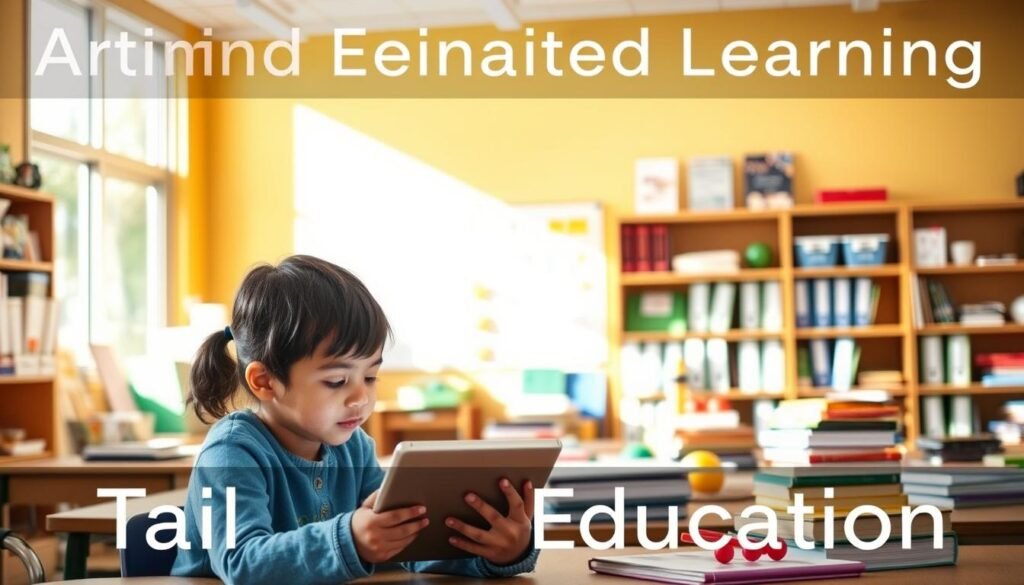
Learner Profiles
Learner profiles are essential for understanding each student’s strengths and challenges. The Gates Foundation emphasizes the importance of detailed profiles that include academic performance, interests, and learning styles. These profiles help educators tailor instruction to meet individual needs.
Amplify CEO Larry Berger compares learner profiles to “snow,” where each one is unique and dynamic. Unlike static transcripts, these profiles evolve with real-time feedback and progress tracking. Schools like Summit Public Schools use software to create and update these profiles, ensuring they remain relevant.
Data privacy is a critical concern in profile creation. Schools must ensure that sensitive information is protected while still providing actionable insights for teachers.
Personal Learning Paths
Personal learning paths allow students to progress at their own pace. These paths are customized based on individual goals and competencies. For example, Yuma School District uses a competency badge system to track mastery in specific skills.
Curriculum mapping technologies play a key role in designing these paths. They help educators align lessons with student needs and ensure a cohesive learning process. Middletown’s progress monitoring system is a great example of how data can guide personalized instruction.
Competency-Based Progression
Competency-based progression focuses on mastery rather than age or grade level. This approach ensures that students advance only after demonstrating understanding. Carnegie Unit tracking is being replaced by more flexible methods that prioritize skill development.
Zone of Proximal Development (ZPD) assessment tools are used to identify the right level of challenge for each student. This method keeps learners engaged and motivated while ensuring steady progress.
| Component | Key Features | Example |
|---|---|---|
| Learner Profiles | Dynamic, data-driven, privacy-focused | Summit Public Schools |
| Personal Learning Paths | Customized, goal-oriented, flexible | Yuma School District |
| Competency-Based Progression | Mastery-focused, ZPD-aligned | Middletown Progress Monitoring |
Implementing Personalized Learning in Schools
Adopting new educational methods requires careful planning and execution. Schools must navigate challenges while leveraging available resources to ensure success. This section outlines steps for effective implementation and addresses common obstacles.
Steps for Successful Implementation
A phased rollout over three years is a proven strategy. Start with pilot programs to test tools and practices. Gather feedback from teachers and students to refine the process.
Funding is critical. Allocate Local Control and Accountability Plan (LCAP) resources strategically. Title I funds can support low-income students, while Title IV grants may cover technology needs.
Professional development is essential. Syracuse’s coaching model provides ongoing support for teachers. This ensures they are equipped to use new tools effectively.
Common Challenges and Solutions
Device procurement is a frequent hurdle. Schools can partner with vendors or explore bulk purchasing options. Middletown’s community engagement approach also helps secure local support.
Building internal capacity is another challenge. Vendor-led solutions offer quick fixes, but long-term success requires training staff. The Plan-Do-Study-Act (PDSA) cycle fosters continuous improvement.
Equity is a concern. ESSA evidence tier requirements ensure that resources are allocated fairly. Challenge-based budgeting can address disparities and promote inclusivity.
“The key to success lies in collaboration and adaptability.”
By addressing these challenges, schools can create a sustainable process that benefits all students. The journey may be complex, but the rewards are worth the effort.
Technology’s Role in Personalized Learning
Technology is reshaping education by offering innovative solutions to meet diverse student needs. From adaptive software to data-driven strategies, schools are leveraging tools to enhance the learning process. This shift is supported by significant investments, such as Summit’s $40M platform, and research highlighting the potential of these technologies.
Adaptive Learning Software
Adaptive learning platforms like DreamBox and Khan Academy are transforming how students engage with content. These tools adjust difficulty levels based on individual performance, ensuring a tailored experience. For example, DreamBox focuses on math skills, while Khan Academy offers a broader range of subjects.
Interoperability standards, such as those by IMS Global, ensure these platforms integrate seamlessly with existing systems. Google Classroom customization further enhances accessibility, allowing educators to adapt content to specific needs.
Data-Driven Instruction
Data is at the heart of modern education. Platforms like NWEA MAP Growth provide actionable insights into student progress. Predictive analytics help identify at-risk students, enabling timely interventions.
However, challenges like rural broadband access and FERPA compliance must be addressed. Blended learning station models offer a solution, combining online and offline tools to ensure equity.
“Data-driven instruction empowers educators to make informed decisions, fostering better outcomes for all students.”
| Platform | Focus Area | Key Feature |
|---|---|---|
| DreamBox | Math Skills | Adaptive Difficulty |
| Khan Academy | Multiple Subjects | Free Access |
By integrating these technologies, schools can create a more engaging and effective learning environment. The future of education lies in harnessing data and tools to meet the unique needs of every student.
Personalized Learning Strategies
Effective education strategies are key to unlocking student potential in today’s classrooms. By focusing on methods like project-based learning and differentiated instruction, schools can create engaging and supportive environments. These approaches empower both students and teachers to achieve better outcomes.
Project-Based Learning
Project-based learning (PBL) is a dynamic strategy that encourages students to explore real-world problems. According to the Buck Institute’s gold standard, PBL focuses on critical thinking, collaboration, and creativity. Loudoun County’s alignment of PBL with tailored education has shown significant success.
Key features of PBL include:
- Cross-curricular projects that integrate multiple subjects.
- Design thinking to solve complex challenges.
- Rubrics from networks like New Tech to assess progress.
Differentiated Instruction
Differentiated instruction (DI) adapts teaching methods to meet diverse student needs. Carol Ann Tomlinson’s framework emphasizes flexible grouping and scaffolded techniques. For example, menu vs. playlist differentiation allows teachers to tailor content based on individual preferences.
Benefits of DI include:
- Improved engagement through varied instruction methods.
- Alignment with Universal Design for Learning (UDL) checkpoints.
- Time management strategies to balance diverse needs.
| Strategy | Key Features | Example |
|---|---|---|
| Project-Based Learning | Real-world focus, collaboration, creativity | Loudoun County’s PBL alignment |
| Differentiated Instruction | Flexible grouping, tailored content, UDL alignment | Carol Ann Tomlinson’s framework |
“Education is not the filling of a pail, but the lighting of a fire.” – William Butler Yeats
By integrating these strategies, schools can create a more inclusive and effective learning environment. The focus on individual needs ensures that every student has the opportunity to succeed.
Personalized Learning and Student Agency
Student agency is reshaping how education is delivered and experienced. By giving students more control over their learning, schools are fostering independence and creativity. This approach aligns with workforce demands for self-directed individuals who can adapt to new challenges.

Empowering Students to Take Control
Empowering students means shifting from teacher-led instruction to student-driven exploration. Summit Public Schools’ goal-setting protocols are a prime example. Students set their own goals, track progress, and reflect on their achievements. This builds skills like time management and self-discipline.
Montessori methods also emphasize student agency. Children choose activities based on their interests, fostering curiosity and a love for learning. These parallels highlight the universal benefits of student-driven education.
Encouraging Self-Directed Learning
Self-directed learning prepares students for real-world challenges. RAND’s research shows that self-paced programs improve understanding and retention. Passion projects and student-led conferences are effective strategies. They allow learners to explore topics they care about, deepening their knowledge.
Digital portfolios are another tool. They showcase students’ work and progress, encouraging metacognitive reflection. This reduces learned helplessness and promotes accountability.
| Strategy | Key Features | Example |
|---|---|---|
| Goal Setting | Student-driven, progress tracking | Summit Public Schools |
| Passion Projects | Interest-based, self-paced | RAND’s Self-Paced Learning |
| Digital Portfolios | Showcase work, encourage reflection | Student-Led Conferences |
“When students take ownership of their learning, they become lifelong learners.”
By integrating these strategies, schools can create an environment where students thrive. The focus on agency ensures they are prepared for future work and personal growth.
Personalized Learning for Diverse Learners
Every student brings unique strengths and challenges to the classroom, requiring tailored approaches to ensure success. Schools must adapt to meet the needs of all students, including those with special requirements and those from diverse cultural and linguistic backgrounds. This section explores strategies to create an inclusive environment that fosters growth for every child.
Supporting Students with Special Needs
Students with special needs require targeted support to thrive. The National Center for Learning Disabilities (NCLD) emphasizes the importance of personalized IEPs (Individualized Education Programs). These plans focus on accommodations and modifications to ensure equitable access to education.
Accommodations adjust how a student learns, such as extended test time. Modifications change what a student is expected to learn, like simplified assignments. Assistive technologies, such as text-to-speech software, further enhance accessibility.
Trauma-informed practices are also crucial. Schools like those in Fairfax County, VA, have implemented programs that address emotional and behavioral challenges, creating a safe environment for all learners.
Addressing Cultural and Linguistic Diversity
Cultural and linguistic diversity enriches the classroom but also presents unique challenges. Education Elements’ equity framework highlights the importance of integrating WIDA standards for English language learners. Multilingual learning management systems (LMS) offer features like real-time translation to bridge language gaps.
Cultural relevance rubrics ensure that lessons resonate with diverse backgrounds. For example, a refugee student case study in Minneapolis showed how culturally responsive teaching improved engagement and academic outcomes.
Family engagement models, such as those funded by Title III, encourage collaboration between schools and families. This fosters a deeper understanding of each child’s background and needs.
| Strategy | Key Features | Example |
|---|---|---|
| Personalized IEPs | Accommodations, modifications, assistive tech | NCLD’s Framework |
| Multilingual LMS | Real-time translation, WIDA integration | Education Elements |
| Cultural Relevance | Rubrics, family engagement, trauma-informed practices | Minneapolis Refugee Case Study |
“Inclusion is not a strategy to help people fit into the systems and structures which exist in our societies; it is about transforming those systems and structures to make it better for everyone.”
By implementing these strategies, schools can create an inclusive environment that meets the diverse needs of all students. This ensures that every child has the opportunity to succeed.
Evaluating the Effectiveness of Personalized Learning
Assessing the impact of tailored education requires a multi-faceted approach. Schools must analyze both immediate and long-term outcomes to ensure students are benefiting from these methods. This involves using reliable data and innovative practices to measure progress and refine strategies.
Measuring Student Progress
Effective evaluation begins with tracking student growth. Tools like NWEA MAP Growth and curriculum-based measures provide valuable information. These tools help educators identify strengths and areas for improvement, ensuring a tailored process for each learner.
RAND’s 2017 study highlights the importance of avoiding whole-school models that may not address individual needs. Instead, schools should focus on competency-based frameworks, such as iNACOL’s assessment model. This approach ensures students master key concepts before advancing.
California’s School Dashboard is an example of integrating multiple metrics for a comprehensive view. It combines academic performance, attendance, and social-emotional data to provide a holistic picture of student success.
Assessing Long-Term Impact
Beyond immediate results, schools must evaluate the long-term effects of tailored education. Longitudinal alumni tracking offers insights into how students perform in higher education and the workforce. Partnerships with employers can also provide valuable information on career readiness.
Value-added modeling adaptations are another tool for assessing impact. This method measures the contribution of a school to student growth, accounting for external factors. It helps educators refine their practices to achieve better outcomes.
Social capital metrics, such as networking opportunities and mentorship programs, also play a role. These factors contribute to student success beyond academic achievements.
“The true measure of education is not just test scores but the long-term growth and success of students.”
By using a balanced scorecard approach, schools can evaluate both short-term and long-term impacts. This ensures that tailored education meets its goals and prepares students for future challenges.
Case Studies of Personalized Learning
Examining real-world examples provides valuable insights into the effectiveness of modern education strategies. By analyzing both successes and failures, educators can refine their practices to better meet the needs of students.
Success Stories from Schools
Middletown, NY, stands out for its progress in closing the achievement gap. By focusing on individual student needs, the district implemented targeted interventions and flexible pacing. This approach allowed students to progress at their own speed, leading to significant improvements.
Yuma School District achieved an enrollment turnaround through its competency badge system. This innovative way of tracking mastery in specific skills engaged students and improved outcomes. Similarly, Summit Public Schools’ non-evaluation decision emphasized growth over grades, fostering a culture of continuous improvement.
Lessons Learned from Failures
Not all implementations have been successful. LAUSD’s MiSiS system faced significant challenges due to poor planning and lack of resources. This failure highlights the importance of thorough preparation and adequate funding.
AltSchool’s technology overreach serves as another cautionary tale. While the schools aimed to integrate advanced tools, the lack of alignment with teacher needs and student realities led to its downfall. NYC iZone’s closure further underscores the need for sustainable models that balance innovation with practicality.
| Case Study | Key Outcome | Lesson Learned |
|---|---|---|
| Middletown, NY | Closed achievement gap | Flexible pacing works |
| Yuma School District | Enrollment turnaround | Competency badges engage students |
| LAUSD MiSiS | Implementation failure | Planning and resources are critical |
| AltSchool | Technology overreach | Align tools with real needs |
“Success in education requires both innovation and practicality. Learning from failures is just as important as celebrating successes.”
By studying these examples, schools can adopt best practices and avoid common pitfalls. This ensures that tailored education remains a viable and effective way to support all students.
Future Trends in Personalized Learning
The future of education is being shaped by rapid advancements in technology and evolving policy frameworks. Schools are adopting innovative tools and data-driven approaches to meet the diverse needs of students. These changes are paving the way for more effective and inclusive educational systems.
Emerging Technologies
Artificial intelligence (AI) is revolutionizing education. AI tutors are being developed to provide personalized support, but regulatory challenges remain. Ensuring these tools are safe and effective is a priority for policymakers.
Extended reality (XR) is another game-changer. Research shows that immersive learning environments can enhance student engagement and retention. Schools are exploring ways to integrate XR into their curricula.
Blockchain technology is also gaining traction. Experiments with blockchain credentials are underway, offering secure and verifiable records of student achievements. This could transform how schools track and share information.
Policy and Funding Considerations
Funding remains a critical factor in implementing these innovations. Chan Zuckerberg’s whole-child funding initiative is a notable example. It supports comprehensive approaches to education, addressing both academic and social-emotional needs.
The Obama-era Race to the Top program has left a lasting legacy. It emphasized accountability and innovation, encouraging schools to adopt new ways of teaching. However, debates continue over the balance between public funding and venture philanthropy.
Digital divide legislation is also gaining attention. Ensuring equitable access to technology is essential for all students. Policies are being developed to bridge this gap and provide equal opportunities.
| Trend | Key Feature | Example |
|---|---|---|
| AI Tutors | Personalized support, regulatory challenges | AI Tutor Development |
| XR Immersion | Enhanced engagement, immersive environments | XR Research |
| Blockchain Credentials | Secure records, verifiable achievements | Blockchain Experiments |
“The future of education lies in the seamless integration of technology and policy, ensuring every student has the tools to succeed.”
By embracing these trends, schools can create a more dynamic and inclusive educational system. The focus on technology and equitable funding ensures that all students have access to the knowledge and tools they need to thrive.
Challenges and Criticisms of Personalized Learning
While tailored education offers numerous benefits, it also faces significant challenges that need addressing. Privacy concerns and equity issues are among the most pressing. These challenges highlight the need for careful implementation and ongoing evaluation.
Privacy Concerns
One major issue is the handling of student data. Audrey Watters has warned about the risks of surveillance in schools. Compliance with COPPA and GDPR is essential to protect students’ information.
Algorithmic bias is another concern. Cases have shown that technology can inadvertently reinforce inequalities. Oakland’s backlash against data privacy violations serves as a cautionary tale.
Integrating IEP data poses additional challenges. Schools must ensure that sensitive information is securely managed while still providing actionable insights for educators.
Equity and Access Issues
Equity remains a significant barrier. E-rate funding limitations often leave rural schools at a disadvantage. Urban areas face their own challenges, such as device donation disparities.
Title I funding models aim to address these gaps, but resources are often insufficient. ELL students face additional hurdles, as schools struggle to provide adequate support.
Digital equity audits can help identify and address these issues. By ensuring fair access to technology, schools can create a more inclusive way of learning for every child.
| Challenge | Key Issue | Example |
|---|---|---|
| Privacy | Data security, algorithmic bias | Oakland’s backlash |
| Equity | Funding, resource disparities | E-rate limitations |
“Ensuring privacy and equity in education is not just a challenge but a necessity for fostering trust and inclusivity.”
Conclusion
The evolution of education continues to shape how we prepare students for the future. RAND’s research highlights cautious optimism, showing that tailored approaches can lead to measurable gains. Models like Summit Public Schools and Yuma’s competency badge system demonstrate the potential for success when innovation meets thoughtful implementation.
However, balancing innovation with risks remains critical. Equitable funding and teacher leadership development are essential to ensure all students benefit. The Gates Foundation’s four pillars—learner profiles, personal paths, competency progression, and flexibility—provide a roadmap for sustainable growth.
Looking ahead, aligning policy with practice will be key. By fostering research-practice partnerships and prioritizing continuous improvement, schools can create systems that empower every student to thrive. The future of education lies in collaboration, equity, and a commitment to lifelong success.